



Most traders don’t fail because they pick bad markets, they fail because they take bad risks. Effective risk management gives you structure, protects your capital, and keeps emotions out of your decisions.
In this guide, you’ll learn how to use stop-losses, position sizing, and clear risk-to-reward ratios to build trades that make sense mathematically, not emotionally.
How Do I Manage Risk When Trading?
Risk management is the process of deciding how much you’re willing to lose, and structuring each trade around that limit before you enter the market. These tools form the foundation:
Use Stop-Loss Orders
A stop-loss automatically closes your position if price moves against you. This protects you from large, unexpected losses, especially in fast-moving markets.
Tip: Place stop-losses based on market structure, not emotions. A useful approach is placing stops beyond a recent swing high/low or beyond a clear support/resistance level so normal price movement doesn’t trigger it. You can also add a small “buffer” (for example 5–10 pips) to prevent getting stopped out by market noise or spread widening during volatile sessions.
Control Your Position Size
Position sizing determines how big your trade is.
Too large → you risk blowing up your account on one bad move.
Proper size → your losses remain manageable even when the market is volatile.
Example:
If you have a $1,000 balance and want to risk 1% per trade, your maximum loss is $10. If your stop-loss is 25 pips, you can take a position where each pip is worth $0.40. That way, a full stop-loss only costs your planned $10.
Avoid Over-Leverage
Leverage amplifies both gains and losses.
A small 0.5% move against you can cause a 10–20% drop in your account if you’re using high leverage.
Apply Basic Risk Controls
- Know your maximum acceptable loss per trade (commonly 1–2% of account balance).
- Avoid trading during major news if you dislike volatility.
- Use alerts to monitor price levels.
What Is a Good Risk-to-Reward Ratio?
Your risk-to-reward ratio (R:R) compares your potential loss to your potential gain.
- 1:2 is a common guideline for beginners → Risk $1 to make $2
- Scalpers may use 1:1 or 1:1.5
- Swing traders often target 1:2, 1:3, or higher
- Breakout traders may have low win rates but high R:R outcomes (1:3–1:5)
There is no “perfect” ratio. Instead, it depends on your trading style, strategy, and market conditions.
How Risk-to-Reward Varies by Trading Style
Different trading approaches naturally produce different ratios:
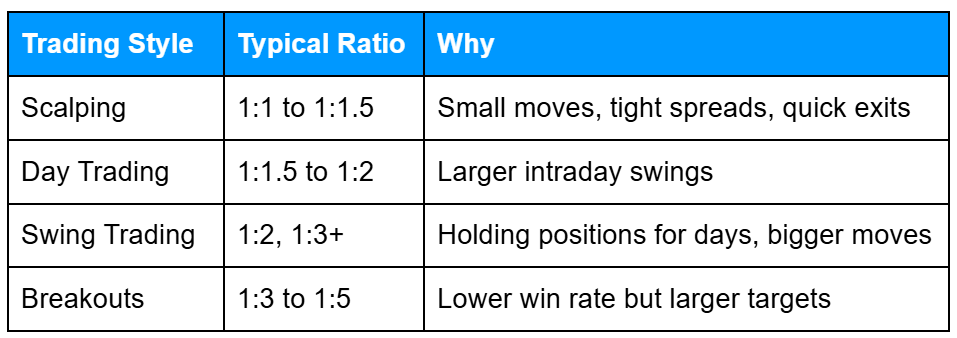
Understanding your style helps you set realistic and consistent R:R expectations.
Risk-to-Reward vs Win Rate: The Full Equation
Profitability isn’t just about how often you win, it’s about the balance between win rate and risk-to-reward.
Example:
- Trader A with a 70% win rate and 1:1 ratio might still break even or lose if losses are emotional or oversized.
- Trader B with a 40% win rate and 1:3 ratio can outperform Trader A despite losing more trades.
Simple Expectancy Formula
(You don’t need to calculate it, just understand the logic.)
Expectancy = (Win Rate × Average Win) – (Loss Rate × Average Loss)
This shows why disciplined traders with high R:R can outperform inconsistent traders with high win rates.
Examples & Visual Scenarios
Example 1: A Winning 1:2 Trade
- Risk: $50
- Target: $100
- Result: Target hit → +$100
Even with occasional losses, consistent 1:2 trades help you grow steadily.
Example 2: A Losing 1:3 Trade
- Risk: $40
- Target: $120
- Result: Stop-loss hit → –$40
A single loss doesn’t hurt much, and long-term expectancy stays positive.
Sample Table: 10 Trades, Mixed Results
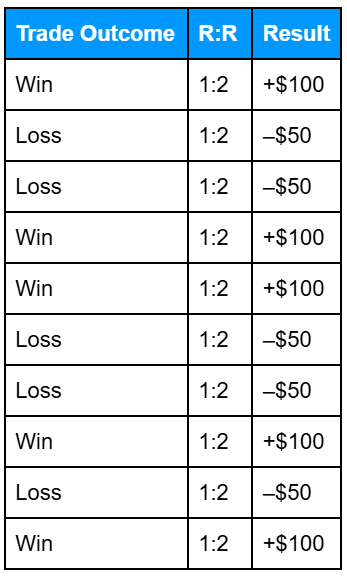
Total result: +$250
Even though only half the trades were winners, consistent 1:2 setups still produced a net profit. This is why long-term discipline matters more than your win rate on individual trades: your math does the heavy lifting.
How Spreads, Slippage & Execution Affect Your Actual R:R
Your planned ratio is not always the actual ratio.
- Spreads: widen during volatile periods, so your stop-loss might effectively be further away.
- Slippage: can turn a 20-pip stop into a 23-pip loss.
- Liquidity: during off-hours, your trade may fill worse than expected.
Tip: Always plan a small buffer around your stop-loss and target to account for real-world execution.
Common Mistakes & Misconceptions
Avoid these behaviours that destroy R:R discipline:
- Moving stop-loss “to give the trade space”
- Closing trades early out of fear
- Entering without a predefined R:R
- Increasing trade size after losing streaks
- Assuming high R:R = guaranteed success
- Setting unrealistic targets that the market rarely reaches
Successful traders focus on consistency, not perfection.
Step-by-Step Guidance: Putting It All Together
Here’s a complete example of applying proper risk management:
Market: EUR/USD
Entry: Buy after a pullback into support
Stop-Loss: Below the previous swing low (20 pips)
Risk: $40
Position Size: Calculated so 20 pips = $40 loss max
Target:
- Conservative: 40 pips → 1:2
- Aggressive: 60 pips → 1:3
Execution notes:
- Check the spread (it adds to your entry cost).
- Volatile sessions may require wider stops.
- Use pending orders if you want precise control over entry price.
This structure helps you plan trades logically instead of reactively.
Using Stop-Loss, Take-Profit & Position Sizing in MT4/MT5
MT4/MT5 make risk management straightforward:
- Set stop-loss and take-profit when placing orders
- Check distance to SL in pips before confirming
- Choose position size based on the stop distance, not desired profit
- Use pending orders for cleaner entries
- Monitor margin levels as larger positions consume more margin and increase risk
Tip: Practice these steps in a demo account before applying them in live markets.
Related Articles
- What is a CFD? Understanding Pips, Lots & Spreads
- Leverage, Margin & Slippage: How They Affect Your CFD Trades
- Trading Risks & Safety: Why Traders Lose and How to Protect Your Capital
Frequently Asked Questions
Q: How do I manage risk when trading?
A: Use stop-losses, size your positions correctly, avoid over-leveraging, and set a clear risk limit per trade.
Q: What is a good risk-to-reward ratio?
A: A common guideline is 1:2 or higher, but ratios vary by strategy and market conditions.
Next Steps
Want to learn more?
Find out about how pips, lots, and spreads affect your trades in our blog on CFD basics.